


SpaceX (SPCX) has been public for two months. In that time, the equity has been 67% above its $135 offering price and more than 20% below it, and it now sits near $146, having covered an enormous distance to arrive close to where it began. Over exactly the same two months, the five bonds that funded the company’s artificial intelligence (AI) build have moved in one direction only, and every tranche now trades below par.
Same company, same period, opposite verdicts. The equity cannot make up its mind. The credit has been entirely consistent, and what it says is that this capital programme costs more than it was sold for.
The capex number the wires could not agree on
Estimates of what the company spent last quarter have been circulating in a range wide enough to change the argument, so it is worth going to the filing rather than the coverage.
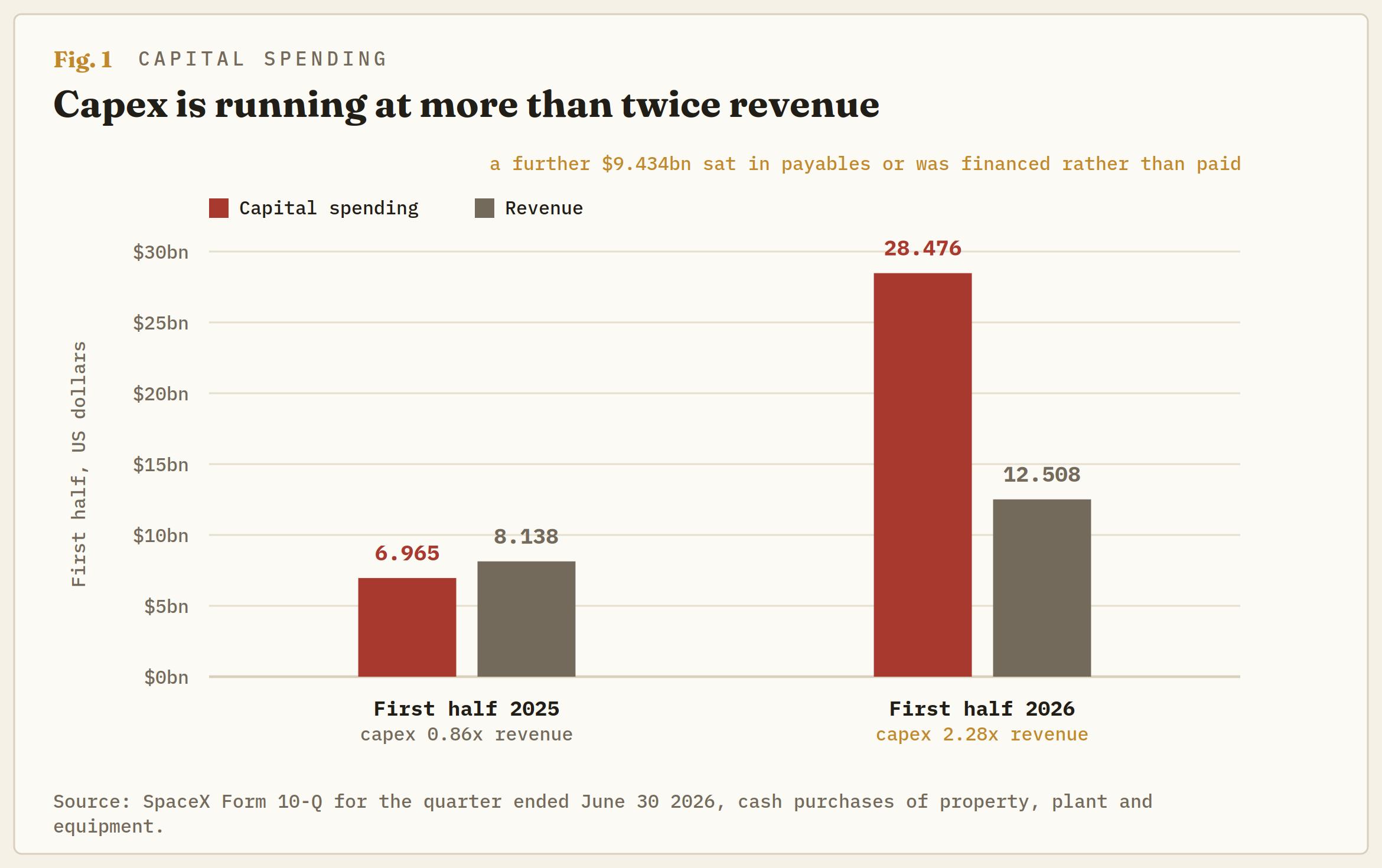
The quarterly report gives six-month figures. Cash purchases of property, plant and equipment ran to $28.476 billion in the first half of 2026, against $6.965 billion in the same period a year earlier. Revenue over the same six months was $12.508 billion. Capital spending is running at 2.28 times revenue, and it has more than quadrupled year on year.
The cash line understates it. A further $5.513 billion of purchases sat in accounts payable and accrued expenses at the balance sheet date, and $3.921 billion more was financed through other arrangements rather than paid for. Add those and the commitment is closer to $38 billion for six months of work.
The composition tells you what is being bought. Servers and networking equipment on the balance sheet stand at $34.771 billion gross, up from $22.694 billion at the end of last year, with data centre infrastructure a further $3.991 billion. The satellite fleet, the asset most people associate with this company, is carried at $13.788 billion. Construction in progress has gone from $4.604 billion to $12.554 billion in six months.
By gross book value, this is now an AI infrastructure company that also launches rockets.
The operating line is nearly clean. The interest line is not.
Here is where the popular framing of this company as a cash bonfire stops being accurate, and where something more interesting takes its place.
In the second quarter, SpaceX generated revenue of $7.814 billion against total costs and expenses of $7.957 billion. That is an operating loss of $143 million on a business turning over nearly $8 billion, which is within a rounding error of breakeven and a dramatic improvement on the $970 million operating loss a year earlier. Revenue grew 92%. The AI segment alone went from $737 million to $2.561 billion, with its solutions and infrastructure line rising roughly sevenfold.
The company still lost $541 million in the quarter. It lost it because it paid $629 million of interest.
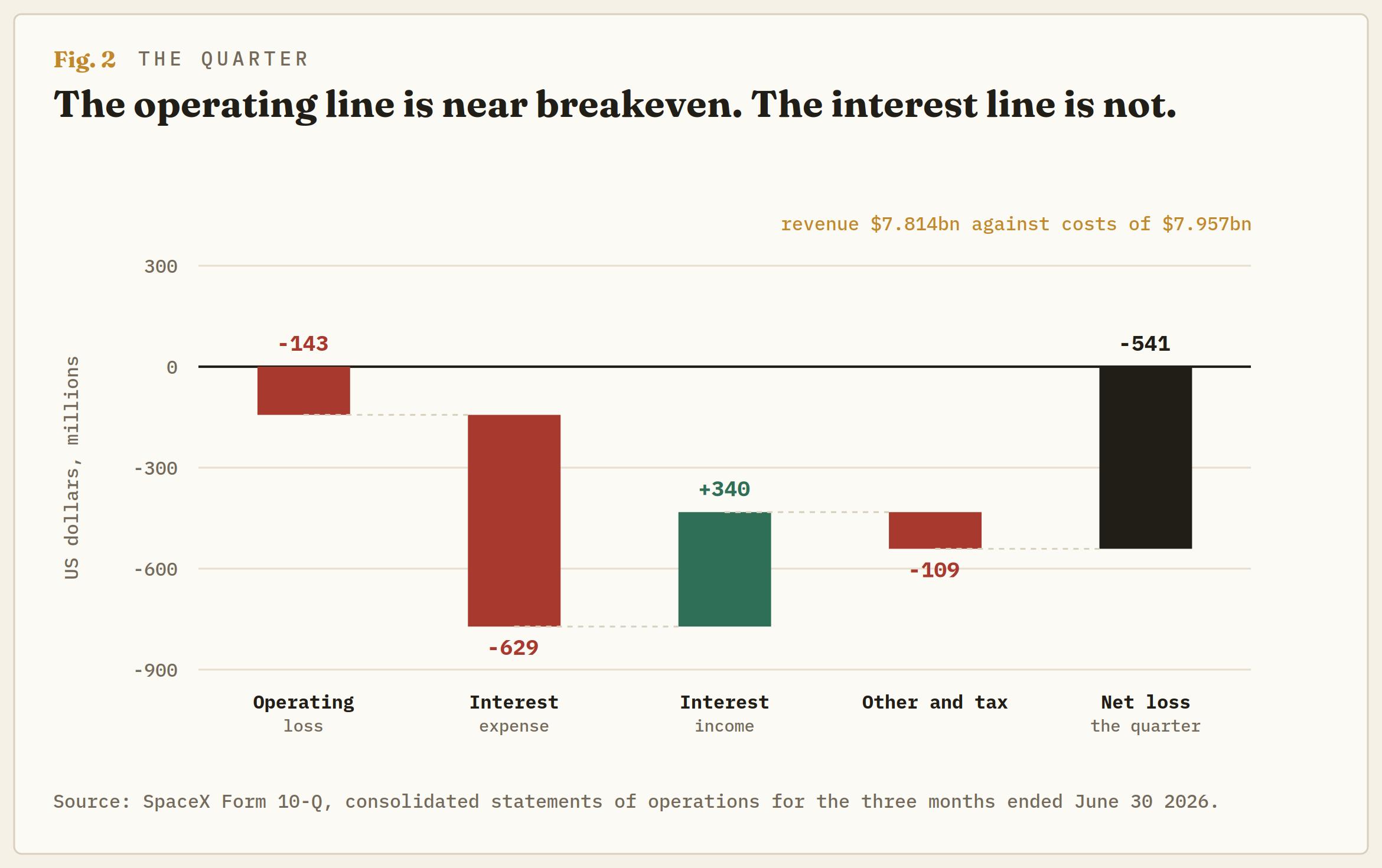
That is the whole argument in one line. At the operating level, the business very nearly washes its own face. The loss exists because the capital programme is debt-funded and the debt now costs more per quarter than the operating shortfall it is covering. Interest paid in the first half came to $1.667 billion against operating cash flow of $3.466 billion, so roughly half of the cash the business generates is going to service the money borrowed to build the thing that generates it.
Nobody is in danger. There is $100.009 billion of cash and marketable securities on the balance sheet and a backlog above $47 billion. But the direction of travel matters, because depreciation on the new assets has barely started. Depreciation was $2.735 billion in the quarter and $5.064 billion across the half, on a gross asset base that has grown by $27.768 billion in six months. The charge that turns capex into an earnings problem is still ahead.
What the bond market is charging
In June, SpaceX raised $25 billion of senior unsecured notes across five tranches, maturing between 2031 and 2056, with a weighted average maturity of 11.7 years and a weighted average coupon of 5.855%. The filing puts the effective interest rate at 6.030% at the end of June.
Every tranche now trades below par, and the discount widens the further out the curve you go.
The 2031 notes, carrying a 5.350% coupon, trade at 98.31 and yield 5.74%. The 2033s at 5.650% trade at 96.84 for 6.21%. The 2036s at 5.875% trade at 94.73 for 6.60%. The 2046s at 6.600% trade at 90.70 for 7.50%. And the 2056s, the 6.650% tranche and the one that prices the company’s terminal value, trade at 89.44 to yield 7.54%.
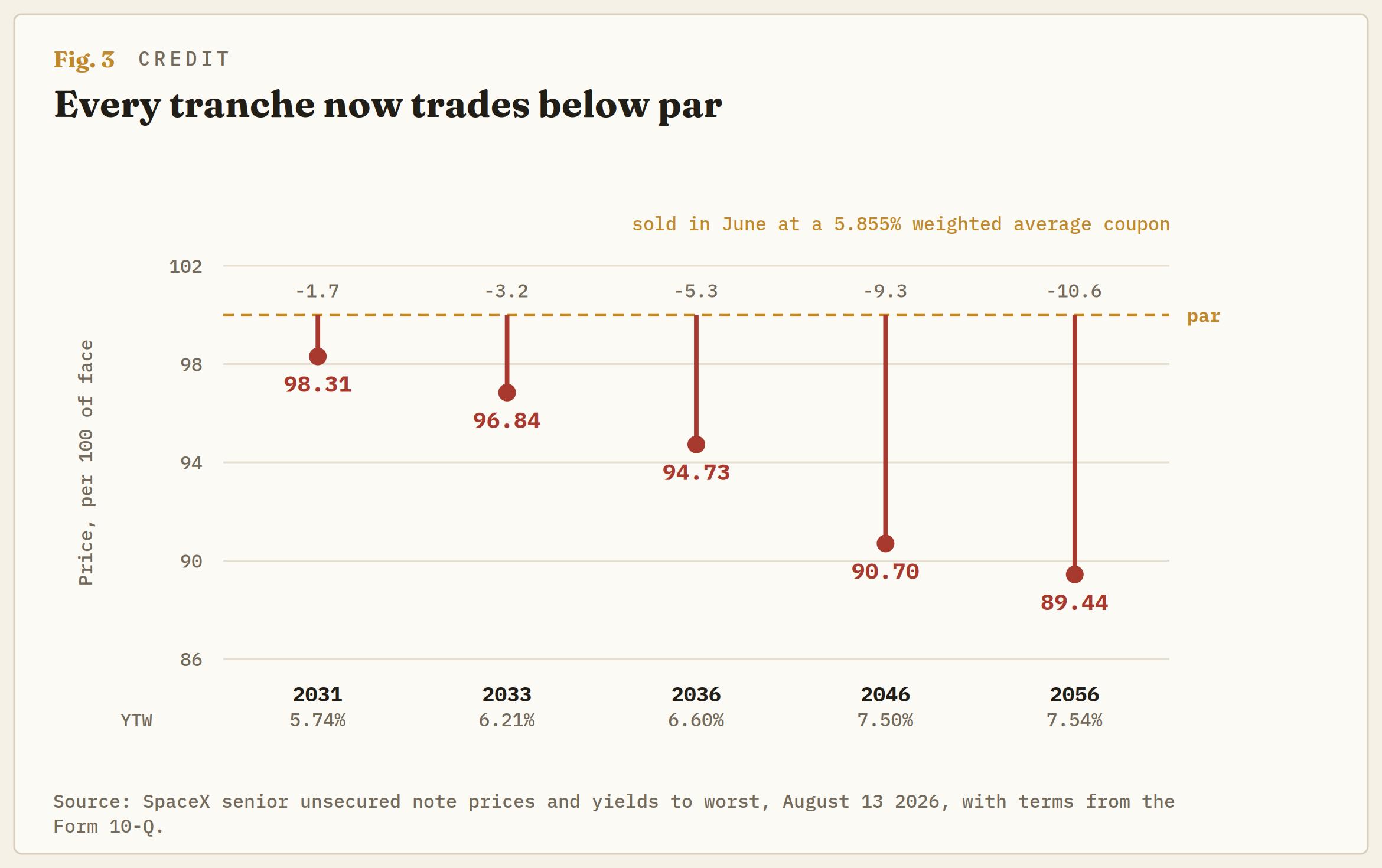
That is roughly ten and a half points of capital loss at the long end in under two months. The 2056s were sold with a 6.650% coupon and now yield 7.54%, about 90 basis points wider, against a blended effective rate of 6.030% across the five tranches when the deal priced. It is worth being precise about what that is not. It is not a distressed credit. The notes carry investment-grade ratings from both agencies that cover them, at the third-lowest rung. The company is in compliance with its covenants and has more cash than debt.
What it is instead is a market charging a high-yield-adjacent 7.5% to lend to an investment-grade borrower for thirty years, and charging progressively more the longer it has to wait. Credit investors are not expressing a view about whether SpaceX survives. They are expressing a view about how much capital gets consumed before the returns arrive, and they have marked that view down every month since June.
The financing nobody is looking at
Two further lines in the debt note deserve attention, because neither appears in the headline $25 billion figure.
The first is $13.406 billion of what the company calls other financings, up from $4.562 billion at the end of last year. The filing describes these as including obligations on certain AI infrastructure assets recorded as failed sale-leaseback transactions. In plain terms, arrangements intended to move data centre assets off the balance sheet did not qualify for that treatment, so both the assets and the matching obligations sit on it. That is a tripling in six months, and it is the fastest-growing piece of the capital arrangement.
The second is related party debt of $13.329 billion across current and non-current, up from $4.507 billion at year-end, on which the company paid $327 million of interest in the quarter alone.
Total debt and finance leases now stand at $39.512 billion. The publicly traded notes are less than two-thirds of that.
The framework from here
The equity and the credit have to reconcile eventually, and the equity is the one that has moved.
Three numbers frame the equity, and none of them is a day’s move. The shares sit roughly 8% above the $135 offering price, about 35% below the June high near $225, and some 40% above the August low near $105. That is the whole map, and it says the market has tried both extreme readings of this company inside eight weeks and rejected each of them.
$150 is the first level that matters, being both the round handle and the area that has capped the recovery from the August low. Above it, the $160 region where the June decline paused comes back into view. Beneath, $135 is the one reference every holder shares, and after two months of trading it now works as support rather than resistance. The August low near $105 only re-enters the argument if the credit view wins outright.
There is a supply event inside that window. Roughly 319 million further shares free from lock-up on August 20, which is the second of five scheduled releases. A market that has just re-rated a name 40% off its low will find out quickly whether the buying was conviction or positioning.
The trade worth watching is not the equity level, it is the spread between the two markets. If the AI thesis is right, the long bonds are mispriced at 89 cents and should converge upward as the capital programme starts generating returns. If the credit is right, the equity has paid a full multiple for spending that has not yet demonstrated it earns anything, and the next re-rating goes the other way.
Watch the 2056s. They are the cleanest available expression of the market’s view on whether this capital programme ever pays for itself, and they have been going the wrong way since the day they were sold.
