


The Federal Reserve (Fed) faces a renewed inflation challenge after two consecutive reports showed price pressure intensifying across the US economy. September’s Consumer Price Index (CPI) confirmed accelerating consumer inflation, while the Producer Price Index (PPI) revealed an even sharper rise in business costs.
Behind both reports lies a common factor: energy prices. But while gasoline is responsible for much of the immediate rise in consumer inflation, diesel may offer a more important warning about what comes next.
Unlike gasoline, which directly affects household budgets, diesel plays a central role in transporting goods, operating agricultural equipment and keeping supply chains running. Its rising cost can, therefore, spread through the economy long after the initial energy shock. For the Fed, the question is no longer simply whether inflation is rising. It’s whether the latest surge in energy costs will turn into broader and more persistent price pressure.
Two inflation reports, one warning for the Fed
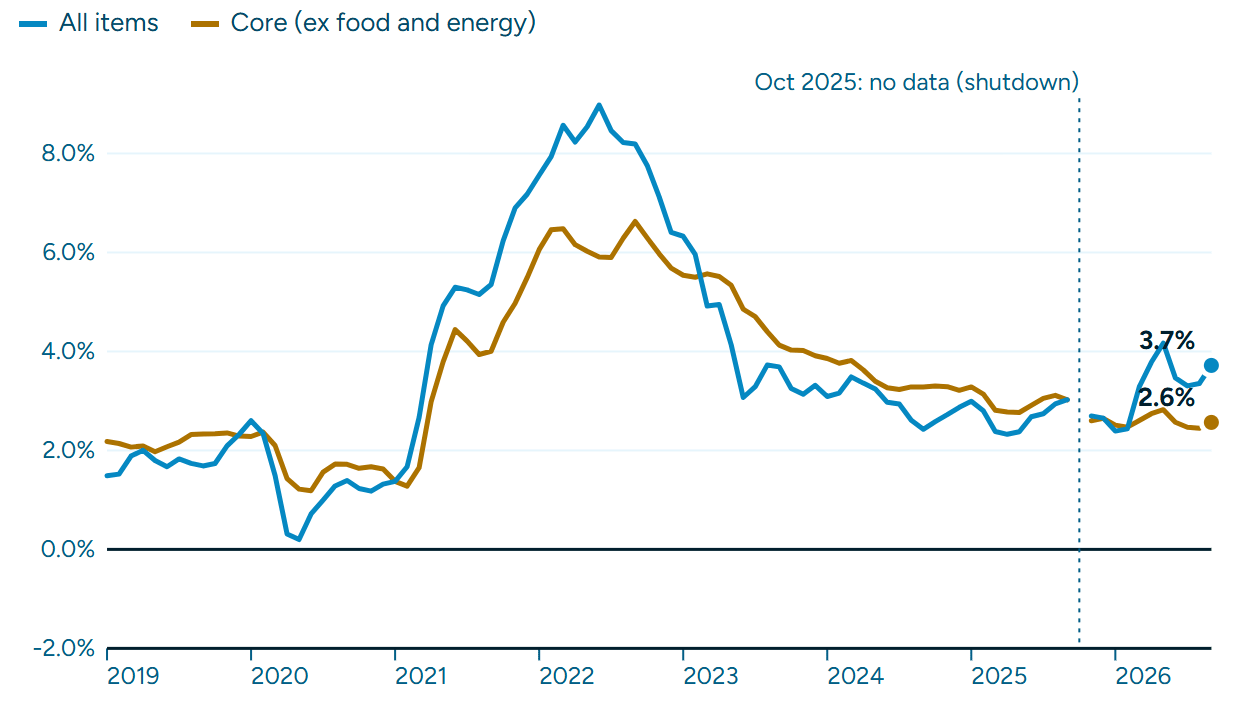
US consumer inflation accelerated to 3.7% YoY in September, up from 3.4% in August. Prices rose 0.6% MoM, with a 9.1% increase in gasoline prices accounting for more than half of the overall gain. Core inflation, which excludes volatile food and energy prices, also strengthened. The annual rate climbed to 2.6% from 2.4%, while the monthly increase reached 0.3%.
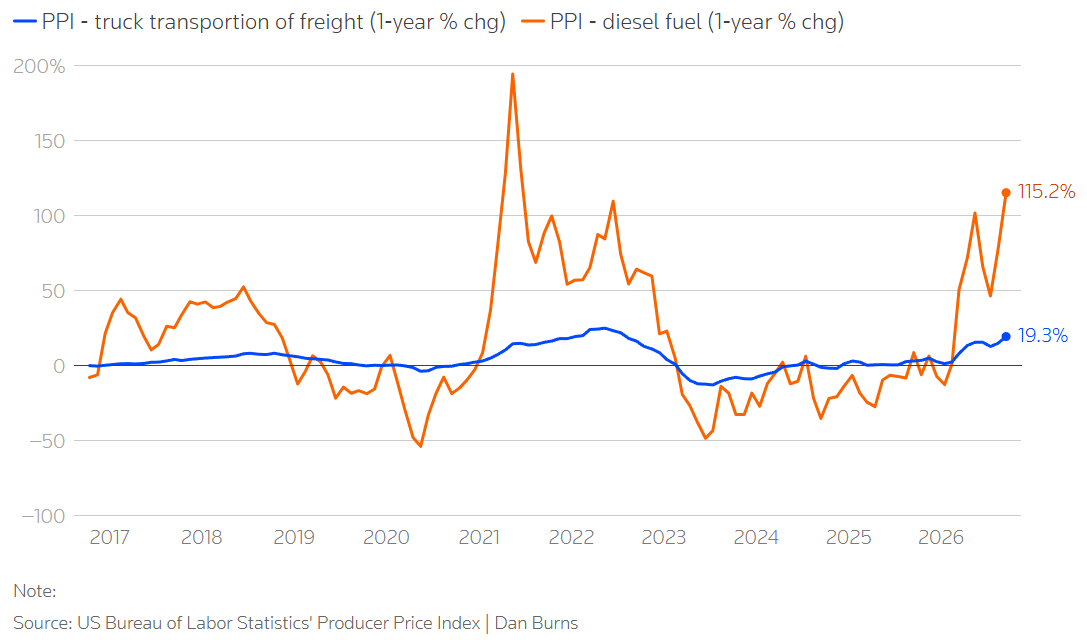
The producer inflation report delivered an even stronger warning. The PPI rose 1.3% MoM in September, bringing the annual increase to 6.3%, its highest level since 2022. Core producer prices increased 0.7% over the month and 5% from a year earlier. Energy costs were the main driver. Producer energy prices jumped 10.8% in September, including a 21% monthly surge in diesel prices and a 20.3% increase in gasoline prices. On an annual basis, diesel prices were up an extraordinary 115.2%.
These figures suggest that inflationary pressure is building at the production and distribution stages of the economy, where businesses may eventually pass higher costs on to consumers.
The distinction matters because producer inflation does not automatically translate into consumer inflation. However, a sustained increase in input costs raises the risk that businesses will adjust their selling prices in the coming months.
Why diesel sends a more troubling signal than gasoline
Gasoline prices attract attention because consumers see them every time they fill their vehicles. Diesel operates differently. It powers trucks, agricultural machinery and a substantial part of the logistics network that moves goods from producers to retailers.
As Oxford Economics puts it: “Diesel is the workhorse fuel of the economy.” That makes diesel a particularly important indicator of inflationary pressure. Higher diesel prices increase the cost of moving food, industrial materials and finished products. They also affect agricultural production, where machinery and transportation are essential throughout the supply chain.
Freight transportation costs are already showing signs of this pressure. The September PPI report showed that trucking freight prices increased 3.8% over the month and 19.3% from a year earlier.
These increases do not necessarily appear immediately in retail prices. Transportation contracts, fuel surcharges and companies’ pricing strategies can delay their transmission. Nevertheless, the longer diesel prices remain elevated, the harder it becomes for businesses to absorb the additional costs.
As Oxford Economics explains, the pass-through can be “lagged and irregular, since it depends on factors such as competitive pressures, contractual arrangements and pricing power”. This delayed effect is precisely what makes the current diesel shock important for the Fed. Even if energy prices stabilize, the costs already accumulated throughout supply chains could continue to influence inflation.
The Beige Book confirms that costs are spreading
The Fed’s own regional economic survey reinforces concerns about the broader impact of rising energy prices. Its October Beige Book reports that “Higher oil prices permeated all District reports,” indicating that the shock is being felt across the country rather than being confined to a few industries. The report also notes: “Firms reported elevated diesel prices and noted that fuel surcharges were passing on increased costs throughout the supply chain.”
This is an important distinction. A temporary increase in Oil prices can produce a sharp but short-lived rise in headline inflation. The risk becomes greater when businesses begin passing higher costs on to customers through transportation charges and product prices.
The longer these adjustments continue, the more likely they are to affect underlying inflation. According to data from the American Automobile Association (AAA) cited by the Associated Press (AP), diesel prices averaged $6.32 per gallon nationwide on Thursday, compared with $3.66 a year earlier. The sharp increase highlights the sustained pressure on transportation and distribution costs, raising concerns that higher fuel expenses could gradually feed through to consumer prices.
The persistence of these prices matters more for inflation than any single daily movement. Meanwhile, strong investment in artificial intelligence (AI) infrastructure and data center construction is adding demand for equipment, materials and electricity, creating another source of pressure in parts of the economy.
Can the Fed really fight diesel-driven inflation?
The central bank’s dilemma is that monetary policy is designed primarily to influence demand, not to increase the supply of Oil or reopen disrupted shipping routes. Higher interest rates can slow borrowing, investment and consumer spending. They cannot directly lower diesel production costs or resolve geopolitical disruptions.
ING makes this limitation clear: “rate hikes will have limited impact on these two price drivers.” The bank also emphasizes the importance of developments in the Middle East: “In terms of the outlook for inflation, much hinges on what happens with the Strait of Hormuz”.
The Fed nevertheless has reasons to remain concerned. If businesses repeatedly pass higher energy and transportation costs on to consumers, inflation expectations could rise and price pressure could become more entrenched. In that scenario, policymakers may decide that tighter monetary policy is necessary to prevent the initial supply shock from spreading further.
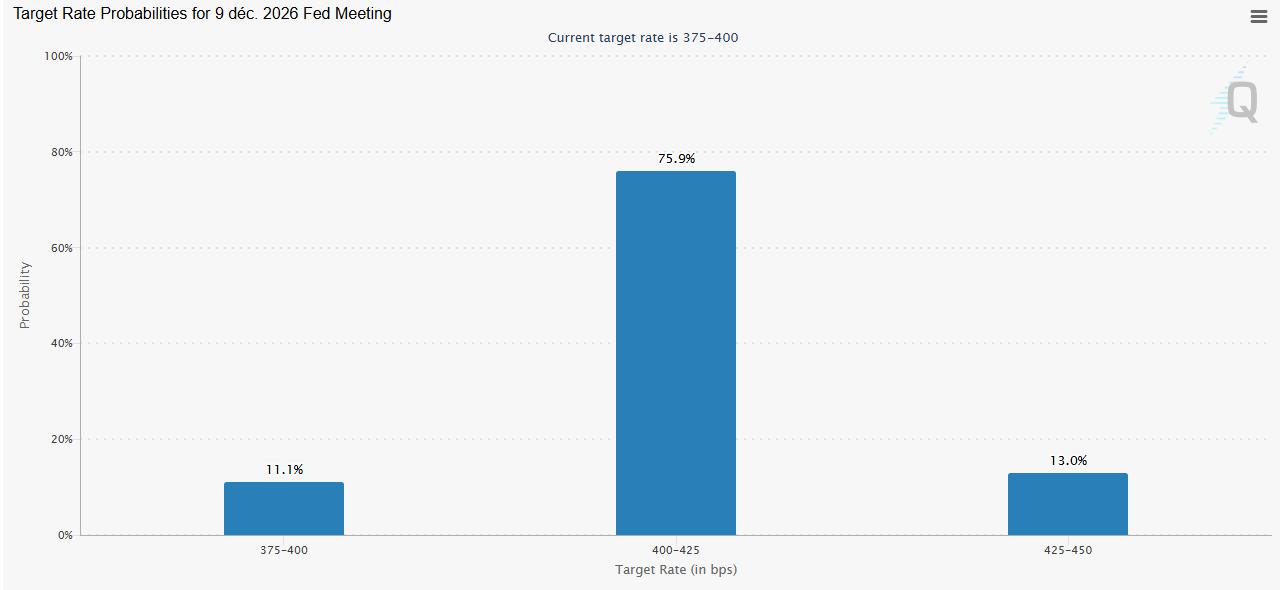
The Fed raised its benchmark interest rate by 25 basis points in September, bringing the target range to 3.75%-4.00%. The latest inflation data have intensified speculation about another increase. Following the inflation data releases, market-implied expectations of an October rate hike briefly rose above 50%, according to the CME FedWatch Tool, although subsequent pricing suggests a lower chance of roughly 15%, while chances for an interest rate hike in December reach 76%.
These shifts highlight how uncertain the policy outlook remains. Fed officials are also expressing different views. Chicago Fed President Austan Goolsbee has emphasized inflation risks, Fed Vice Chairman for Supervision Michelle Bowman has favored waiting for more information, New York Fed President John Williams has indicated that one additional rate hike may be appropriate, and Dallas Fed President Lorie Logan has suggested that two hikes could be necessary.
The disagreement reflects the unusual nature of the current economic environment. The Fed must decide how aggressively to respond to inflation that is partly driven by factors outside its control, without unnecessarily weakening an economy already showing signs of strain.
The Fed’s next move depends on how persistent the shock becomes
The Fed’s October 27–28 meeting will take place against a backdrop of unusually conflicting economic signals. Inflation is accelerating, producer costs are rising sharply, and diesel prices are feeding into transportation and distribution expenses. At the same time, underlying retail spending is weak, real wages are under pressure and job creation has slowed.
The central question is whether the current energy shock will remain concentrated in fuel prices or evolve into a more persistent increase in the cost of goods and services. If diesel prices remain elevated, businesses could continue passing higher costs through supply chains, keeping inflation above the Fed’s target even after the initial surge in gasoline prices fades.
If energy markets stabilize and transportation costs begin to ease, the inflationary impact could prove more temporary. That uncertainty leaves policymakers with limited room for error.
Another rate increase could reinforce the Fed’s commitment to price stability, but it would do little to address the original supply disruption. Holding rates steady could protect an increasingly fragile labor market, but it risks allowing broader inflationary pressures to take hold.
The latest CPI and PPI reports have, therefore, delivered more than two uncomfortable inflation readings. They have revealed a transmission mechanism that could keep pushing prices higher in the months ahead. For the Fed, diesel is not simply another energy price to monitor. It is an early warning of how today’s supply shock could become tomorrow’s consumer inflation.
