


The Bank of England left Bank Rate unchanged at 3.75% but delivered a distinctly hawkish message as its inflation outlook deteriorated sharply. Three policymakers voted for an immediate increase to 4%, while Governor Andrew Bailey warned that a prolonged Middle East conflict and wider second-round effects could require tighter policy.
A divided MPC and policy tightening on the cards
The Monetary Policy Committee (MPC) voted 6-3 to maintain the Bank Rate at 3.75%, in line with expectations. Chief Economist Huw Pill and external members Megan Greene and Catherine Mann preferred a 25-basis-point increase to 4%, highlighting the growing concern about persistent price pressures. The MPC also voted unanimously to continue unwinding its gilt holdings.
The inflation projections were the most striking part of the decision. The BoE now expects consumer price inflation to exceed 4% in early 2027, compared with a previous forecast for a 3.2% peak in October-November 2026. Although the bank repeated that there was still little evidence of material second-round effects, it acknowledged that inflation risks were tilted to the upside relative to its July forecast.
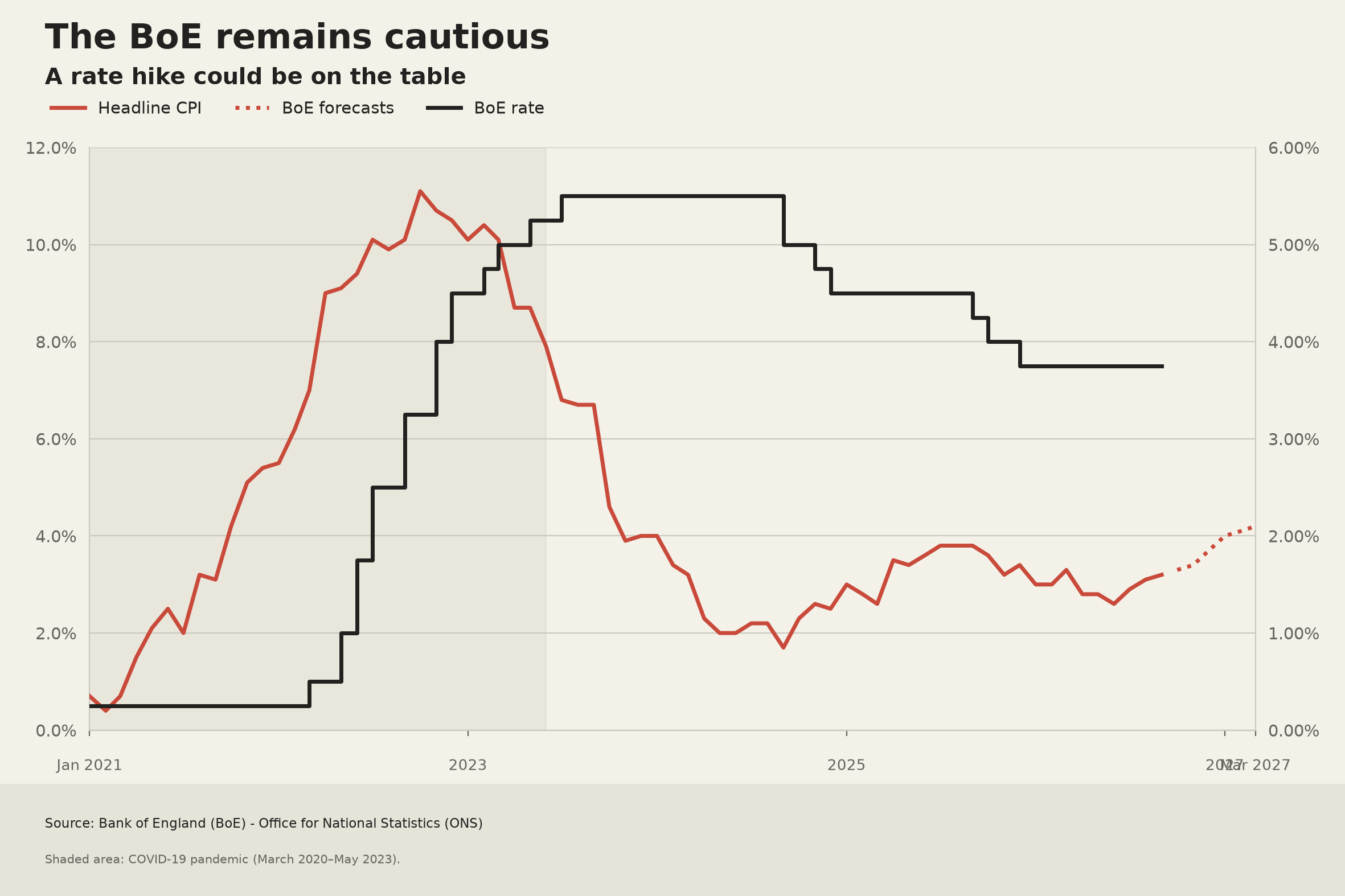
Bailey said policy might have to tighten if the Middle East conflict persisted for an extended period and the risk of second-round effects increased. Energy prices remain the immediate concern, but the BoE is also watching how higher costs feed into wages, services and broader price-setting behaviour. At the same time, the MPC continues to take a cautious approach because inflationary pressures are not yet clearly broad-based.
The growth picture offered some relief. Third-quarter GDP growth is now expected at 0.4% (from the 0.1% projected in July), while manufacturing, consumer confidence and services have improved. The labour market remains relatively robust, although employment growth is slowing, and exports continue to face challenges related to competitiveness and trade policy.
The BoE confirmed that QT will continue at an average annual pace of £46 billion through to 2034, including £20 billion of active Gilt sales alongside maturities. Auctions will be paused until April 2027 while the central bank considers whether some Gilts could be sold to the government rather than the market. Long-dated holdings will remain in the Asset Purchase Facility (APF) to back banknotes and will be replaced as they mature.
Overall assessment
The BoE delivered a hawkish hold. It did not raise rates, but the sharp upward revision to the inflation outlook, the 6-3 vote and Bailey’s warning about possible tightening make this far more than a routine pause. The bank is still waiting for evidence of second-round effects, but the threshold for renewed rate increases has clearly moved lower if energy prices remain elevated or inflation broadens.
