


One example I’ve noticed gaining traction on Reddit is the argument that investors should break up with their bond exchange-traded funds (ETFs). We’ve previously explored a variation of this idea through the proposed 40/30/30 portfolio, which allocates 40% to stocks, 30% to bonds, and 30% to alternative investments. Its proponents argue that adding alternatives can provide better risk-adjusted returns than the traditional balanced 60/40 portfolio of equities and fixed income.
This discussion gained momentum following 2022, when an unusual combination of high inflation and rapidly rising interest rates produced historically poor returns for bonds in the same year as a stock market slump. Fixed-income investments, normally expected to provide some stability during equity market downturns, suffered substantial losses of their own. For example, according to Portfolio Visualizer, the iShares Core Canadian Universe Bond Index ETF (XBB) lost 11.67% in 2022. By comparison, the iShares S&P/TSX 60 Index ETF (XIU), which tracks 60 of Canada’s largest publicly traded companies, declined by a comparatively modest 6.36%.
Compounding the problem was the increased correlation between stocks and bonds. In 2022, XBB exhibited a correlation of 0.52 with XIU. A correlation of 1 indicates that two investments move perfectly together, while a correlation of zero indicates no linear relationship. That positive correlation meant bonds offered relatively little diversification benefit precisely when investors might have wanted it most.
It’s understandable why this experience caused some investors to question the role of bonds in their portfolios. If bonds can lose more than stocks during a bear market while simultaneously moving in the same direction, what exactly are they accomplishing?
But that’s also where recency bias raises its ugly head. The conditions that prevailed in 2022 were unusual, and extrapolating that experience indefinitely could be just as problematic as assuming bonds will always protect against equity losses.
So, should Canadian investors really ditch their bond ETFs? Let’s examine the evidence on both sides and consider some potential ETFs depending on which argument you find more convincing.
The case for breaking up with your bond ETF
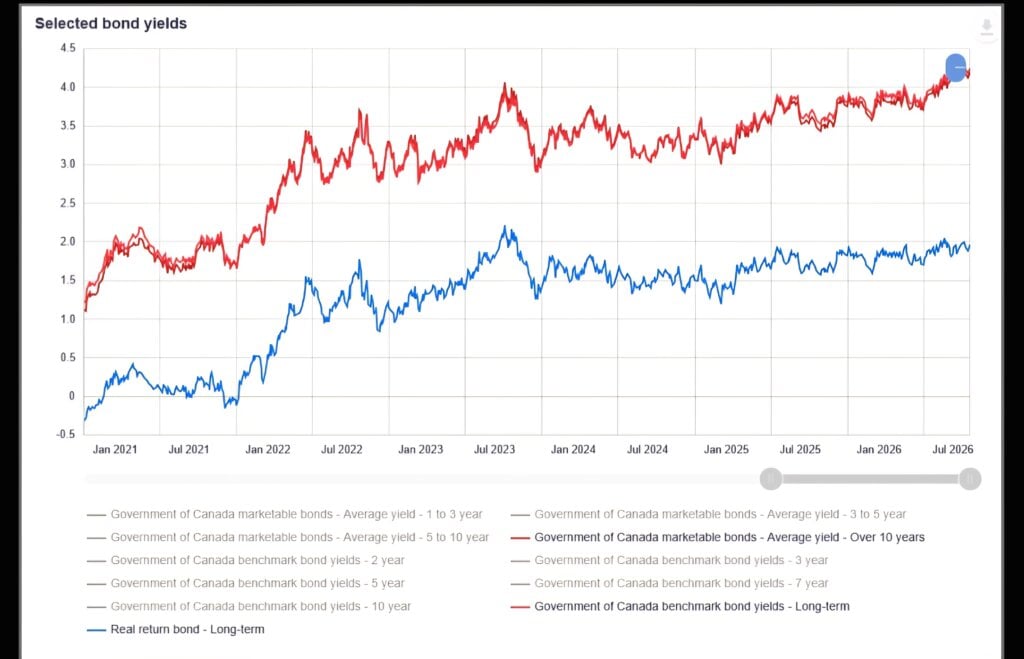
The strongest argument for reconsidering traditional bond ETFs starts with the direction of government bond yields. According to the Bank of Canada’s historical data, yields on Government of Canada marketable bonds have generally moved higher since the exceptionally low levels reached during the COVID-19 pandemic, although the increase has been interrupted by periods of declining yields.
The trend has affected different maturities, including longer-term bonds and inflation-indexed real return bonds. As of October 19, 2026, the benchmark 10-year Government of Canada bond yielded 3.93%, while the long-term benchmark yielded 4.25%. The long-term real return bond yield stood at 1.97%.
Source: Bank of Canada
Part of the explanation may be the growing concern about government borrowing and the compensation investors demand for lending over longer periods. Statistics Canada’s government finance data illustrates the pressure. In the first quarter of 2026, the federal deficit reached $19.4 billion, an increase of $3.3 billion from the same quarter a year earlier. Federal liabilities increased by $100.4 billion, including $78.8 billion in additional debt securities.
Larger deficits generally require more government borrowing. All else equal, increased bond issuance can put upward pressure on yields as governments compete for investors’ capital. Investors may also demand additional compensation for inflation uncertainty, fiscal sustainability concerns, and the possibility that interest rates remain elevated for longer than previously anticipated.
None of this necessarily means that Canadian government bonds are becoming unsafe from a credit perspective. Rather, investors can demand higher yields even from borrowers considered highly creditworthy when the inflation and fiscal outlook becomes less predictable.
Compounding this is renewed uncertainty over monetary policy. The U.S. Federal Reserve raised interest rates in September for the first time since 2023, reversing its previous easing cycle. In Canada, the possibility of a Bank of Canada rate hike at its October 28 meeting has also become increasingly credible.
Statistics Canada’s latest Consumer Price Index (CPI) report showed inflation rising 3.1% year over year in September, up from 3.0% in August and slightly above the Bank of Canada’s 1% to 3% target range. Gasoline prices were a major contributor, increasing 27.8% year over year. Excluding gasoline, inflation was considerably more subdued at 2.2%, which complicates the case for further tightening.
Still, policymakers also need to consider inflation expectations. If households and businesses begin anticipating persistently higher prices, those expectations can influence wage negotiations, spending decisions, and pricing behaviour. That raises the possibility of interest rates remaining elevated or moving higher to contain inflation.
Finding a viable bond ETF replacement
For bond ETF investors, the concern is straightforward. Bond prices move inversely to yields. When newly issued bonds offer higher yields, existing bonds paying lower coupons become less attractive. Their market prices must fall until their effective yields become competitive with newly available securities.
