


The global economic landscape has been fixated on the Middle East since the US-Iran war started in late February, reacting to significant changes in crude Oil prices and assessing how they could influence inflation dynamics and growth outlook. Major central banks, including the Federal Reserve (Fed), made it clear that the conflict raised upside inflation risks, forcing them to move away from policy-easing intentions and reprioritizing price stability. But as the conflict potentially moves toward a resolution and Oil prices decline, another factor could complicate the inflation outlook: the Artificial Intelligence (AI) investment boom.
Oil prices may fall, but AI could keep inflation sticky
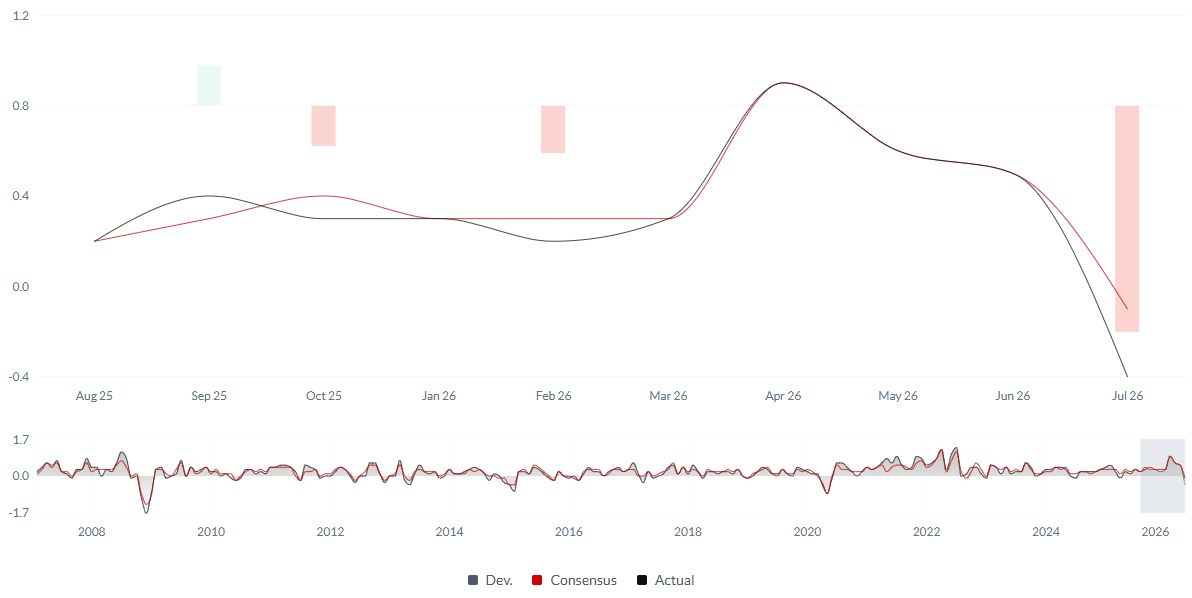
There is still a lot of uncertainty surrounding the situation in the Middle East, but a resolution to the conflict could trigger a sharp decline in Oil prices as supply constraints are removed. Initially, this could lead to lower energy costs and help inflation come down. In fact, the barrel of West Texas Intermediate (WTI) declined by about 20% in June as markets started pricing in a Memorandum of Understanding (MoU) between the United States (US) and Iran to end the war. That easing in energy prices was reflected in June inflation data, with the US Consumer Price Index (CPI) falling by 0.4% on a monthly basis, its largest monthly decline since April 2020, shortly after the Covid-19 pandemic was declared, and the annual rate of CPI inflation eased to 3.5% from 4.2%.
While energy prices remain under the spotlight, the Artificial Intelligence (AI) technology boom sits as a factor in the background that could complicate the inflation outlook. Hence, the Fed could face a rude awakening if lower Oil prices prove insufficient to tame inflation, exposing a tech-driven undercurrent that could keep core prices sticky.
Phase 1: The inflationary AI capital boom
The massive wave of capital expenditure pouring into the AI infrastructure could offset lower energy prices and limit core inflation’s downside. In a research paper published in May, the Fed assessed how the “Computer Software and Accessories” category of the Personal Consumption Expenditures (PCE) Price Index made an “unprecedented contribution to the rise in core and core goods inflation.”
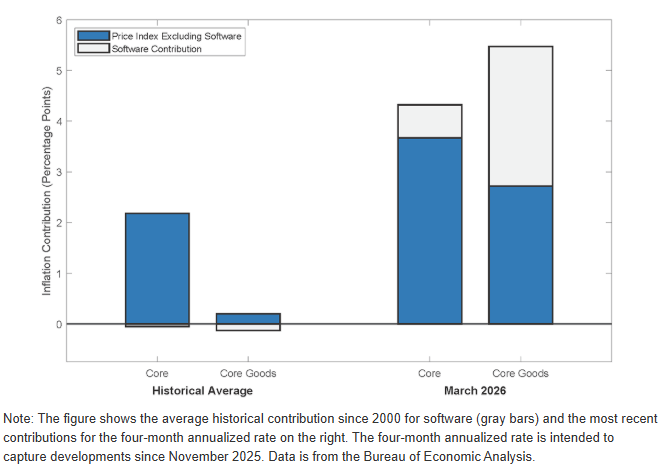
“Since November, the annualized difference between core PCE and core PCE excluding software is two-thirds of a percentage point. This is a notable contribution as core PCE has risen 4.4 percent (annualized) over the last four months and is particularly striking given that the software category comprises only 1.2 percent of the core PCE basket and has trended downward for decades,” the Fed noted and explained that the “unusually large software readings are an important driver of the recent elevated levels of core goods inflation.”
In recognition of this trend, analysts at TD Securities noted that while AI has the potential to improve productivity and reduce costs over the long term, the initial buildout phase is creating significant demand for labour, materials, power and equipment. “That surge in demand can place upward pressure on prices and interest rates before productivity benefits are fully realized,” they added.
Phase 2: The disinflationary productivity leap
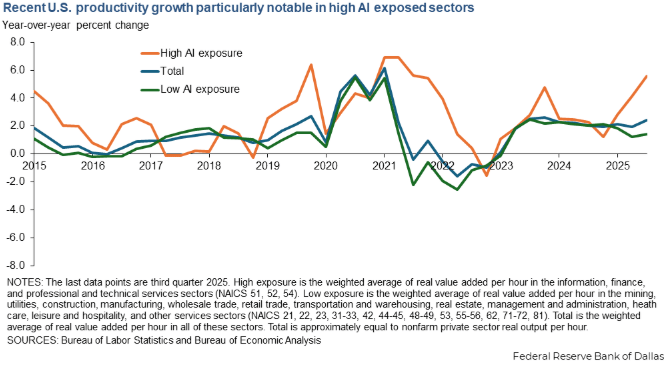
The counterargument to the near-term inflation risks is a productivity improvement in the long term via wider adoption of AI technologies, which could help bring prices down. The Dallas Fed recently published an article in which the author, Scott Davis, talked about the positive relationship between AI exposure and labor productivity growth, especially in the information, finance and insurance, and professional and technical services sectors. “Average annualized productivity growth since first quarter 2024 for these three sectors is 3.7 percent compared with 1.7 percent for the rest of the economy,” Scott said.
In a joint research initiative, Atlanta and Richmond Fed banks surveyed approximately 750 corporate executives to evaluate operational realities of AI integration. “AI adoption is already widespread and associated with measurable revenue-based labor productivity gains, and these gains operate primarily through innovation- and demand-oriented channels rather than capital deepening,” the paper read and further noted that the evidence suggested that “AI’s nearterm labor market effects are characterized less by aggregate job losses and more by shifts in tasks and occupational exposure across workers.”
In theory, productivity gains should translate into an increase in Total Factor Productivity. That would be seen as workers generating more output per hour, causing the Unit Labor Costs to decline. In a competitive market, reduced marginal costs of production should lead to lower prices to consumers to capture market share. In short, widespread productivity growth driven by AI adoption should pave the way for a positive supply shock and have a disinflationary impact on the economy.
The Fed faces an AI-driven inflation dilemma
The Fed will face the challenge of navigating these contradictory dynamics using a blunt toolkit. There is what is known as a “long and a variable lag” when the central bank adjusts interest rates. It takes a long time for an increase or a decrease in the interest rate to have a material impact on the economy. Additionally, the Fed only chooses to adjust rates when there is enough evidence that warrants such an action.
In case the AI boom keeps core prices sticky for consecutive months, even after energy costs come down, the Fed could come under pressure to tighten monetary policy by hiking the interest rate. If the timing is not right, policymakers run the risk of stifling the economy that might be on the verge of enjoying productivity-led supply growth.
If the Fed ignores the stubbornness of core inflation and refrains from tightening the policy, it might cause markets to lose confidence in its ability to provide price stability. Additionally, the central bank might also be forced to adopt an even more aggressive stance in the future if it takes longer than expected for the productivity leap to lead to disinflation.
I believe this exact dilemma is one of the main reasons why Fed Chair Kevin Warsh set up five task forces to evaluate the Fed’s use of existing data, productivity and jobs, communications, economic forecasting models and the baseline inflation framework. While testifying before Congress, Warsh stated that the “data that’s being used to judge inflation is quite imperfect.”
What the AI-inflation dilemma means for the US Dollar
In these uncharted waters, the US Dollar’s (USD) fate is likely to depend on how confident markets are in the Fed’s ability to keep inflation under control, while ensuring the economy is operating at its potential. Hence, the traditional positive correlation between the interest rate and the USD’s valuation, where lower rates would cause the USD to weaken and vice versa, could break down. As long as markets trust that the Fed will use new methods of forecasting and data analysis to successfully step around those traps and create the ideal macroeconomic environment for the AI boom to drive the economy to new heights, the USD could continue to outperform its rivals over the long term.
US Dollar FAQs
The US Dollar (USD) is the official currency of the United States of America, and the ‘de facto’ currency of a significant number of other countries where it is found in circulation alongside local notes. It is the most heavily traded currency in the world, accounting for over 88% of all global foreign exchange turnover, or an average of $6.6 trillion in transactions per day, according to data from 2022.
Following the second world war, the USD took over from the British Pound as the world’s reserve currency. For most of its history, the US Dollar was backed by Gold, until the Bretton Woods Agreement in 1971 when the Gold Standard went away.
The most important single factor impacting on the value of the US Dollar is monetary policy, which is shaped by the Federal Reserve (Fed). The Fed has two mandates: to achieve price stability (control inflation) and foster full employment. Its primary tool to achieve these two goals is by adjusting interest rates.
When prices are rising too quickly and inflation is above the Fed’s 2% target, the Fed will raise rates, which helps the USD value. When inflation falls below 2% or the Unemployment Rate is too high, the Fed may lower interest rates, which weighs on the Greenback.
In extreme situations, the Federal Reserve can also print more Dollars and enact quantitative easing (QE). QE is the process by which the Fed substantially increases the flow of credit in a stuck financial system.
It is a non-standard policy measure used when credit has dried up because banks will not lend to each other (out of the fear of counterparty default). It is a last resort when simply lowering interest rates is unlikely to achieve the necessary result. It was the Fed’s weapon of choice to combat the credit crunch that occurred during the Great Financial Crisis in 2008. It involves the Fed printing more Dollars and using them to buy US government bonds predominantly from financial institutions. QE usually leads to a weaker US Dollar.
Quantitative tightening (QT) is the reverse process whereby the Federal Reserve stops buying bonds from financial institutions and does not reinvest the principal from the bonds it holds maturing in new purchases. It is usually positive for the US Dollar.
